Originally published in Zombie Creeping Flesh fanzine
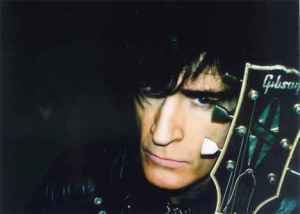 Sonny Vincent has been a punk rock musician since 1976. He spent his formative years fronting The Testors in New York City’s early CBGB milieu alongside bands like the Dead Boys and The Cramps. Projecting am image of the quintessential New York punk underdog with an attitude, he went on to sing and play guitar in The Model Prisoners, The Extremes, Shotgun Rationale and countless other groups. Extreme hard-headedness and a bad reputation have marked his path ever since, as has his habit of turning up his guitar amp way too loud.
Rarely one to record more than a 7” single with any particular outfit, Sonny managed to release four full-length albums with Shotgun Rationale between 1989 and 1994. For the remainder of the 90s, Sonny Vincent collaborated with punk rock veterans such as Cheetah Chrome of the Dead Boys, Captain Sensible of The Damned and Scott Asheton of The Stooges. Due to his fierce live shows, he soon became one of the punk underground’s best-loved exponents of Stooges-derived destructo-rock.
Sonny Vincent’s 2003 show at a Camden Town bar in London was the last I heard of him. The gig was part of his European tour, and once again Sonny wheeled in an impressive line-up, sharing guitar duties with Ivan Julian of Richard Hell’s Voidoids, while an achingly skinny-legged Bobby Steele of the early Misfits tormented his bass strings with a relentless series of downstrokes. It was a classic Sonny Vincent show: raw, gutsy, and as usual, the sheer volume was something to remember him by.
In conversation, Sonny made a friendly and sweet impression. At the same time, there is little doubt that he has an overbearing confidence and possibly a big ego, which may well be a reason why he went through so many different bands.
Why do you always have so many punk rock celebrities playing on your records? From a purely musical point of view, does it really make such a massive difference whether it’s Captain Sensible playing the bass or lesser known musician?
Oh, that’s a big difference. When I choose musicians, it’s like an artist choosing his palette of colours. I don’t get them just because they’re famous, I really think about their style and how it would suit my music. I’m very lucky because most musicians in the world will play with me, so I have the freedom to choose them how I like. As for Captain Sensible: in addition to being a really sweet and great man, he’s a fantastic bass player.
To what extent is the music completely under your control, and to what extent do you permit your backing musicians to influence it?
It’s very egotistical on my part: I control it from the beginning until the end. If someone has an idea that sounds really cool, I’ll have a listen. But mostly, it’s my own vision. If you have too many people cooking one dish, it becomes crazy. It’s no good, at least from my experience.
Although you were been mostly lived and played in Europe in the 90s, you went to the US just to audition 300 musicians for a tour. Why not audition European musicians?
I prefer American musicians because Europeans don’t have the same environments in their neighbourhoods. We’re lucky, we grow up around a lot of black people. We grow up with Motown and soul, and that’s what creates a certain vibe in the neighbourhood. My music is called New York punk rock. If you listen to the New York bands, the music has swing. Whereas if you listen to the English bands, it’s very tight and rigid: (imitates a fast 2/2 beat) duh-duh-duh-duh-duh, I want anarchyyyy!, dud-duh-duh-duh…
It’s very stiff and white. The New York bands swing – just listen to Johnny Thunders. I can’t find that swing in Europe. I’m sure it exists, but I haven’t found it yet. It’s more of a mixed culture in the US. If you grow up in a place where you hear Spanish music from one house, and Motown from another, and maybe Wagner playing in a third… that’s a lot of different cultures influencing you. But if you only hear AC/DC and Led Zeppelin growing up, that’s a more limited culture. I don’t want to piss anybody off, but that’s my opinion.
You formed your first band, the Testors, in 1976. Can you tell me something about those early years, and what was it that made you want to play music?
I just knew I wanted to do music. When I was in kindergarten and they were teaching us how to read, they showed us those pictures that showed the mother, the father, the policeman, the bus driver, and so on…you know, those picture from books to teach children how to read? You would always see the father cutting the grass and the mother washing the dishes. And I thought: I’m not gonna be cutting the grass! That’s when I knew I would do something out the ordinary.
The Testors were one of my first bands. At first we were very experimental. My songs in the early Testors, none of which were ever recorded, all consisted of only one part. Normal rock’n’roll songs have three or four parts, whether the really early Testors only had one.
Something along the lines of Teenage Jesus and the Jerks?
Exactly. Later we had two parts, and then three, and then four… (laughs)
Tell me about the first Testors show ever.
We played our first show at CBGB’s. The other two guys had never been on stage before. I had been on stage three times before, so I thought I was a big expert and talked down to the other guys, “Guys, in the music business it’s like this and that…”
I told them: if you play a wrong note, don’t look embarrassed, pretend you’ve just played the best thing ever. We had thirty-two songs on our set list, and we practiced them in the same order every day. I told them “no matter what happens, finish the song.”
On the night, the CBGB’s was packed. I said to the drummer, “listen, we can’t play our first song, this crowd will hate it. We’ll start with the second one.” The drummer almost fainted because we had always been rehearsing the set in the same order! Then I went over to the guitar player, “look dude, I can see the first three songs will not work with these people. Start with number four”. He looked at the set list confused and began to sweat.
When the drummer counted us in, I started playing the 8th song. Obviously, all you could hear then was just one big noise. My bandnates ooked at each other, and then at me helplessly: “Where do I go now, what’s happening? Sonny said never stop until the song’s finished…”
So I was doing a kind of performance art on the audience and my own group. Finally, when the noise went down after about three minutes, there was a few seconds of silence and then loud applause and cheering from the crowd.
That’s when I knew: I can do anything. And that’s when I really went crazy, when I knew I could get away with anything.
The Testors also played shows with the Dead Boys at the CBGB. Were the Dead Boys really as wild and self-destructive as their reputation suggests?
Not at all. Stiv Bators was a sweet and friendly guy. Backstage, Stiv was the mother hen of the band. He was putting hairspray in all the other guys’ hair, asking them whether they were nervous… but when he got on stage, he suddenly turned into this animal, shouting and knocking everything over. I liked Stiv a lot. They weren’t very self-destructive. When they did their first album, they were only drinking beer. The other stuff came much later.
Did you expect commercial success when you first started?
Our idea was: we’re here, and the world will come around to where we are. And then we will have commercial success. But we never dreamed of making music to match the world.
How do you survive then, you don’t seem to be selling enough records to support yourself?
I always seem to make it until the next tour. I’ve got a couple of friends with those nice credit cards, and after the tour they come back to remind me how much I owe them. They’re supporting the arts, so to speak. I always pay them back after the tour.
On your website, you’re complaining about major labels not being supportive of ‘the scene’. What scene are you referring to? You don’t seem much of a ‘scenester’ to me, more of an outsider type.
Everybody knows that big labels don’t do the right thing nowadays. In the 1960s, if you had a couple a groups make it, then thirty or forty more would come along with them. First you had the Beatles, then the Stones, the Kinks, the Who, and so on. Nowadays, they only take a couple of bands and pump tons of money into them. When you listen to the radio, they just play their two or three big sellers over and over.
In the early 90s, for example, it was Nirvana and Whitney Houston. It wasn’t Nirvana, Mudhoney, Lemonheads, and so on, do you see what I mean? It was Whitney Houston, Michael Jackson, Nirvana – those strange corporate blocks. That’s what I was writing about: they’re not supporting any scenes or musical movements, they just pick a couple of moneymakers. Sometimes they try, but even then they get it all wrong. When Nirvana made it, they went to Seattle and signed up Pearl Jam, thinking “they’re from Seattle too, they’re the same”. It didn’t sound the same to me, though.
Do you find it important that they can play, or do you believe in that 1977 punk ethos “anybody can do it?”
It depends on who it is. You mentioned Lydia Lunch earlier: none of the musicians back in those days had much experience, but in their own way, they had lots of talent. If you go into a music store, you’ll probably find a guy with a guitar who knows every note that was ever done, but he just sits there shredding away and trying to impress everybody. To me, that guy is like a secretary who can type really fast.
If you’re a writer and want to write a book, it doesn’t matter how fast you type. Some famous writers type really slowly, letter for letter. But six months later they have a masterpiece. Whereas the secretary might type at lightning speed, but she doesn’t write masterpieces, she writes business letters.
If it comes from the heart, it doesn’t matter whether it’s fast or slow, primitive or sophisticated. What Nick Cave does is very sophisticated, and he only uses very good musicians. But his music is soulful and deep. Another group might have a similar sound and play just as well, but be phony and fake all the same.
You played with Mo Tucker of The Velvet Underground, who comes from an entirely different generation of musicians. Was it difficult for her to adapt to your hard and fast style?
Mo is really cool. We once went on tour with Half Japanese. Me, Mo and Half Japanese were all in the same band. We did half Mo Tucker songs and half Jad Fair songs. But Jad had to go home because he got sick, so we ended up doing half Mo Tucker songs and the other half my Shotgun Rationale songs. It was really cool, because it was very loud and fast, and Mo was just killer.
Mo has a very specific taste, her biggest idol is Bo Diddley. She doesn’t mind if it’s fast and loud, she just doesn’t like heavy metal. Same as me.
What is the special thing about punk rock that sets it apart from other forms of rock?
The fact that the people who play it realise that they possibly aren’t choosing the most direct route to get where the money is. This, in turns, means they have a little bit more dedication. When people do something from the heart and because they have something to say, it just seems more culturally important than whatever they play on the radio.
What do you have to say?
I have a lot to say. But today, I want to say something about voting. Do you go voting in elections? The next time you’re about to go and you look at the newspaper or television, a man with a really friendly face will come on. He has a couple of nice children and a dog, and they will show his backyard with all the flowers. He’s a family man trying to speak honest to the people, and he will say: “I want what’s best for the community.”
Don’t vote for this asshole because he’s a lying, fucking actor. I suggest you pick the ugliest, most stupid man when you vote. The ugly, stupid one is probably only half of an asshole – he can only lie so much. If you’re lucky, you might get some truth out of him. But the pretty, lying bastard – don’t vote for him.
Note as of January 2017: On Sunday January 2, 2016, Sonny Vincent’s family was struck by a tragic accident. Due to a gas explosion that ignited into a blazing fire, three of his family members have suffered extensive injuries and burns. A year on, they are still in need of serious medical attention, which isn’t paid for by the virtually nonexistent public healthcare system of the United States. If you want to help, please donate to Sonny’s gofundme account, or pay directly to his PayPal address, sonnyvincentpersonalmail@gmail.com
Sonny frequently posts updates on his family’s recovery on his Facebook page.