Originally published in Zombie Creeping Flesh fanzine
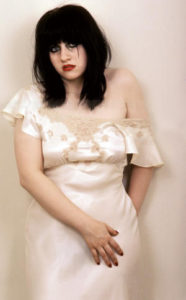
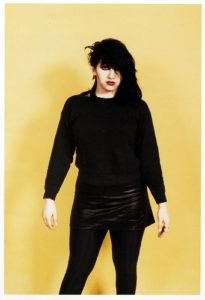 Aged only 14, Lydia Lunch ran away from her suburban Rochester home to immerse herself in the early New York City punk scene. Amateur footage filmed at the CBGB’s in 1976 reveals her as an early Dead Boys groupie and keen self-promoter from an early age.
Soon she fronted the incredibly abrasive Teenage Jesus and the Jerks, whose noisy assault spearheaded New York’s ‘no wave’ movement. 1980 saw the release of her first solo album, a radical departure from Teenage Jesus: instead of shrill guitar noise, Queen of Siam offered lazy Lolita-vocals breathing urban ennui over jagged big band grooves. Along with her 8-Eyed Spy project, which indulged in experimental swampabilly, this has remained Lydia Lunch’s most universally acclaimed work in a fickle music world.
Unlike many contemporaries from the New York underground who burnt out after one or two releases, Lydia has remained active and her work relevant. Since the 1980s, she has been involved in countless projects, collaborating with the likes of Einstürzende Neubauten, Rowland S. Howard and Sonic Youth. Whether music, photography, film, writing or spoken word, everything she does is radical and uncompromising. Most of all, she has preserved an ability to surprise and challenge rather than rehash former glories.
‘Like a wine that gets better with age’ is an over-used analogy, but it fits Lydia Lunch like her pointed heels: with Matrikamantra, which contained a sensual silent film music of sort, she released her most intriguing work more than twenty years into her career as a recording artist.
The post-millennial years saw Lydia veer towards an even more cinematic direction, topping her previous work yet again with Smoke In The Shadows, which evoked a film noir atmosphere of seedy bars and lost souls. Unlike many avantgarde artists, Lydia Lunch understands that one needs to captivate the audience’s emotions to stimulate their intellect
This interview was conducted when Lydia toured Europe performing songs from Matrikamantra.
Teenage Jesus and the Jerks kicked off your career as an artist in the late 70s. What were your goals and ideas at that point?
The goal of Teenage Jesus was to destroy rock music as I knew it. I wanted to resolve the influences that had moved me to create music in the first place: Richard Hell, Patti Smith and so on. The idea was to abolish their music and replace it with something far less traditional.
You weren’t happy with the late 70s New York punk scene?
Oh no, I liked it very much. But I thought it was my duty to try and have a rebellion against it. It influenced me to run away and go to New York, but at some point I felt it was too traditional, so Teenage Jesus was formed. I formed Beirut Slump around the same time, who sounded exactly the opposite of Teenage Jesus.
In the beginning, every band I formed was a rebellion against what I had already created. Later I decided to form 8-Eyed Spy: rock music, which I hate. To me, they were what rock music should be, but also an insult against everything I had done. I had to rebel not only against everything else, but also against myself. I do it all the time, ha ha!
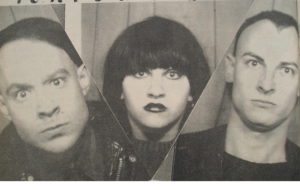 Do you think the No Wave movement had any lasting effect on music?
Oh definitely. It had a bigger influence on avant-jazz and people like John Zorn, not so much on rock music. Of course, Sonic Youth, who were the second or third wave, had a very big influence, and their original influences were the bands from the No Wave. So in essence, it was a ripple effect.
I don’t know if no wave changed anything, I just think that every period where people create extremes of musical culture will have some kind of influence and educate the next movement. But of course, in the last 15 years or so, everything has been going backwards, which is dangerous. It’s not moving forward from what already existed.
What do you mean specifically?
MTV, the Rolling Stones on tour, Spin Magazine, mainstream alternative.
What are your thoughts on today’s ‘alternative’ music?
I think there must be an alternative, but it’s not on MTV, and it’s not covered by mainstream press. It’s far more difficult now to find out about our extreme musical visionaries because everybody has this cheap MTV overnight success dream. There has to be a rebellion against that, and I’m sure there is. MTV is really what spoils people. Everybody thinks they too can be a big success, which is a ridiculous reason to create anything.
You once said that you were afraid of becoming to popular with 8-Eyed Spy, is that correct?
I quit the band because I didn’t like the infatuated look in people’s eyes, it was disgusting. On the most popular night of our existence I quit the band because I thought people were coming for the wrong reason. I hated it.
But if you’ve got a message that you want to get out…
… (interrupts) yeah, but that’s why I had another band after and after. I’m not constantly changing what I do to keep success away, but I have to create at my own pace, which is much faster than what the media or the public can keep up with. This is only the second time in my entire career that I’ve put out an album and gone on tour to promote it, the other time was Shotgun Wedding. Usually, I put out a record and then the project is over.
In this format at the moment, it’s easier to evolve. I’m only working with one or two other people. I can change the concept with one person as it goes along, instead of saying “this band was good for that feeling, now it’s time to get another one”.
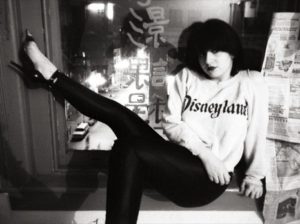 But generally speaking, if your message is important, isn’t more accessible music more likely to carry it to people?
Yeah, but my job is to speak to the sexual, intellectual and political minority, not to the majority. I know my message is important, but I refuse to play the games you have to play in order to get the message out to more people. Like most visionaries, I think it will be in my death that I will be recognised. Like the Marquis de Sade, like many great painters, like many great writers: when they die, then there’s success.
I’m successful because I can do anything I want, with everyone I want, when I want. I can support myself as an artist because I don’t have a ridiculous lifestyle, and I don’t like expensive things or drugs. Therefore, I’m the most successful living artist I know.
Have you never been into drugs?
I was never into heroin, so that saved me. It’s because I’m fickle: today I like this, tomorrow I like that. That’s why it was never one drug that intoxicated me so much… and they stopped making the drugs that I liked in the early 80s, which was good for me. I did a lot of drugs, I drank a lot, but I never had an addiction to anything. I’m addicted to adrenaline. Insanity is my addiction. Insane men are my addiction, and pretending I’m a psychiatrist for all their problems, ha ha!
In the course of you career, you used very explicit sexual imagery, which some called pornographic.
Oh yeah, say the word: pornographic. It’s not an insult.
 Did you want to explore your sexuality, turn people on, or did you set out to shock?
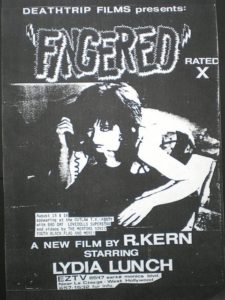
Very good question. Okay, first of all, let’s talk about all my films with Richard Kern in the early 80s, Fingered and so on. When I saw Fingered, I was disappointed. I thought it wasn’t hard or sexual enough, it wasn’t violent enough. But I lived this, so to me these 20 minutes [of violent hardcore sex] were nothing. Other people did not feel the same way, ha ha! They were very shocked that I could show that, as if I were different to any other woman, actress, or human being. But because I was Lydia Lunch they asked, ‘how could you show that?’
My duty is to show what everyone else wants to ignore, hide, or consider taboo. My job is to get to the root of obsession.
Exactly. First of all they are not erotic films, pornographers do not like them. You can’t show in pornography what we showed in Fingered. To me, pornography has only one goal, and this is where I defend it: pornography’s only goal is to relieve frustration. But my goal is often to stimulate frustration, to express frustration, to articulate frustration. So in a sense, pornography and I are worlds apart.
But I cannot think of another woman who has shown the dark obsessions we have to deal with – for violence, for sado-masochism, for death ultimately. And why we arrive at this conclusion as women is often through early abuse, sister trauma, and so on… One becomes numb, one feels nothing. The only way to feel something is in extremes. That’s the point of these films. With Fingered, I wanted to make a film that was like a drive-in trailer, a ten minutes coming attraction: no point, no boring dialogue, action! To detail these obsessions in a drive-in trailer was what we had set out to do with these films.
It’s my social duty as a woman to express these dark obsessions because nobody else is expressing them for us. And also to eliminate tabloid sexuality. I was not interested in making erotic films. I may one day want to make a very beautiful, passionate, sexy, erotic film whose only goal is masturbation, but that wasn’t the goal with these films.
Of course, everyone has a different reaction to them. But I never think anything I do is shocking. Other people think that I’m a radical, extreme, shocking pornographer, which is a beautiful term by the way. But we did not set out to make shocking films. We set out to document psycho-sexual insanity.
 So the task was to make realistic films?
About my reality, yes. The whole thing about Fingered is to show that if you are battered – consciously even, because often we know what we’re doing but we don’t know why – the goal is to figure out why. You are the first victim, then you become a victimiser. In Fingered, she’s taking all of this insanity, and in the end she turns it against another woman. That’s what so many people failed to realize, because I didn’t have a disclaimer with the moral written. But why make it easy?
Are you pro-porn, even mainstream porn?
Yes I am. Because of the goal I told you, and also because I think that what one does in the privacy of their homes is perfectly fine. We should have every fetish that we want to satisfy, as long as we know why we’re driven by these obsessions. What’s more, pornography does not exploit women, it exploits men. Men always look ridiculous, they’re chasing pussy as if it’s the gold from the Mayan temples. Women look beautiful. Therefore, I’m a great defender of pornography, and I’ve had many debates with people that are anti-porn.
Feminists, I assume?
Feminists too, and also lawyers. To me, the Catholic church has the most pornographic iconography: the nude man tortured and bleeding to death. Now that’s pornography. To me, pornography is war, it’s poverty, it’s homelessness. That’s pornography in the true sense, not X-rated films showing people having sex like we all do. Or want to do, more often than we actually do.
Can you tell me about your latest projects, and how they’re different to what you were doing 15 or 20 years ago, how your objectives have changed?
Well, I think my path is linear, I think I’m on a straight road with my words and music. I released Paradoxia, which is a full circle from the Richard Kern films. With the Richard Kern films, I really started to investigate in my own sexuality. Paradoxia is about the accumulation of this insanity and the end result: as women, we have to demand pleasure, but we also have to learn that we can’t be looking for someone else to fulfill and satisfy us. The ultimate goal is that both women and men learn not to always look outside themselves to be fulfilled – they have to fulfil themselves.
And I have released the Matrikamantra CD. What we do is twisted lounge music, but only in parts. It’s a kind of psycho-ambient, but it’s still very dark and heavy. I think this music is an obvious progression for me. Music that is more seductive, yet the words and the passion are still very hard. I can’t say this music is totally sexual – it may have a seductive feeling, but still there’s heavier meanings. You’ll see tonight how it has changed from the recording.
Is there anything else you ‘d like to tell the readers?
Heal yourself. Find a way to create, and find alternative methods to do it. Don’t always look to pick up a stupid guitar to create. As a matter of fact, burn the guitars and drums immediately. Not that everybody should play electronic music, but what about a tuba, saxophones or washboards? Forget everything you’ve learned as a cultural consumer and try to create your own genre, whether it’s with painting, photography, music or film.