Originally published on my private blog in 2008
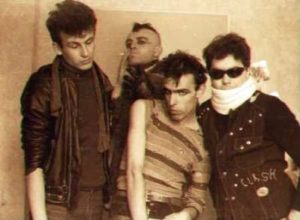 Punk didn’t have it easy in ‘socialist’ Bulgaria, a country in which all aggressive rock music was suppressed. This didn’t keep Novi Cvetya (“New Flowers”) from playing it as early as 1979. Based in Kyustendi, a medium sized town close to the Serbian border, the lads benefited from being able to listen to punk rock on Yugoslav radio. Maybe that is why their sound more strongly resembled late 70s Yugo-punk bands such as Paraf and Pankrti than anything British or American. Novi Cvetya’s songs are simple and have a typically Balkanese tongue-in-cheek feel and sense of the absurd.
While Yugoslavia, an unaligned and more culturally permissive ‘socialist’ country than Bulgaria, allowed homegrown punk talent to release records on the state-owned Yugoton label, there was no such option for Novi Cvetya. Even tape recorders were prohibitively expensive, but eventually the band managed to cut a demo tape, 10-15 copies of which went into circulation. These songs and all of the group’s further recordings resurfaced on a fantastic 2004 CD entitled Radiacija 1979-1995 in a limited edition of 1000, by now a collector’s item in its own right.
 Formed in 1981 in Bulgaria’s capital Sofia, DDT played amateurish, tinny-sounding Oi punk influenced by UK 82 combos such as The Exploited and the obligatory Yugo-punk groups. Never the most likely band to be granted a release on the state-owned Balkanton label, a posthumous album entitled Best compiled the bulk of their 1982-1992 material. Of historical interest only.
In February 1984, the vice president of the state council, Georgi Dzhagarov, declared that “the whole country has been upset by the muddy stream of musical trends sweeping away all true values of music”. Bulgarian cultural officials launched a major campaign to eliminate rock culture, and punk culture in particular: anybody sporting punk or heavy metal fashions in public was likely to be stopped by police and have their subcultural insignia removed.
However, due to the government’s incompetent execution of cultural policy and the punk rockers’ indifference towards official decrees, punk culture continued to exist all across the country. In January 1986, punks scandalised an official New Year’s Eve celebration in central Sofia by appearing en masse with spiked hair, mohicans, and torn clothes. The Bulgarian press finally admitted their existence while bemoaning “serious aesthetic aberrations” in the music scene.

1987 saw tactical liberalisation when Communist Party intellectuals began to realise that suppressed youth subcultures could evolve into serious political opposition if no concessions were made. Party newspapers Narodna Kultura and Rabotnichesko Delo published articles calling for official acceptance and controlled support of Bulgaria’s punk and heavy metal scenes.
In the wake of these changes, Balkanton offered a selected few ‘punk’ bands to release albums on the state-owned label. The best of these were Reviu, a Sofia band fronted by the flamboyant and highly talented Milena Slavova, often referred to as the ‘Bulgarian Nina Hagen’. Punk rock this was not: Reviu’s sound was more akin to new wave played by professional musos. However, this shall not detract from the qualities of the band, whose self-titled 1989 debut album is recommended listening.
A 1989 performance of their song Ala Bala can be seen in the YouTube clip below.
In 1987, the First Sofia Rock Festival featured Reviu and other new wave/cold wave bands such as Kontrol and New Generation, both of which secured album deals with Balkanton. Bulgaria’s first rock’n’roll movie Direktor na vodopad of 1989 documented Reviu, their fans, and the general public’s reactions to the new phenomenon (click here for the full movie in Bulgarian language). Today, Milena is an eccentric middle-aged lady who still lives in central Sofia and continues to be involved in various musical projects.
Whether encouraged by this liberalisation or in opposition to the officially sanctioned ‘punk’ groups, a hardcore punk underground also began to thrive in the late 1980s. Kokosha Glava from Kurdziali, a small town near the Turkish border, played fast and rough oi/hardcore from 1988 onward. Song titles such as Kill Kill Police ensured they would not be mistaken for a Balkanton band. A retrospective entitled Punk, Anarchy, Nihilism 1989-95 compiled all their early tapes, but is now out of print. Other bands from this period included U.Z.Z.U. from Gabrovo – a female fronted band that foolishly lost their only master tapes when passing them on to John Peel; Abort from Varna, another Exploited styled Oi troupe; and Taran, also from Varna, who liked their punk rock with a more ’77 flavour.
Then it was all over. In February 1990, the Communist Party relinquished its power, and a new era began. After two years of ‘smooth transition’ overseen by the moderate Bulgarian Socialist Party, a new government led by the rightwing Union of Democratic Forces left no stone unturned when privatising the country. Soon, Bulgaria encountered the ‘blessings’ of the kind of cutthroat capitalism imposed upon all ex-Eastern Bloc countries: uncompetitive industries went bankrupt, unemployment figures skyrocketed, wages reached an all-time low. Bulgaria was thrown into a huge crisis, symptoms of which included empty shops, high crime rates, and abandoned children in the streets. Another cancer sore of capitalism followed suit: vast amounts of neo-Nazi boneheads began to terrorise Bulgarian streets, kickstarting a problem of fascist violence that persists to the present day.
Many veteran punk rockers drifted into heroin addiction, others had bigger worries than keeping the music scene alive. Balkanton went bankrupt, which effectively meant the death of the Bulgarian record industry. The few punk bands of the 90s either played pale imitations of American new school hardcore or pop punk in the style of Green Day and Offspring. None of them produced anything of interest or lasting value.
 Things have been picking up steadily in the past years in Sofia and Plovdiv, Bulgaria’s second largest city. This is largely due to the efforts of Endless Party Booking of Sofia, who are in the process of turning the capital into an unlikely glam punk mecca of the Balkans, and the work of Plovdiv’s Amplifire Magazine. Equipped with an impeccable music taste, a record collection that would make New York and London scenesters blush with envy, and with Johnny Thunders as their patron saint, Liubo and Vicky of Endless Party must be credited with single-handedly creating a new Bulgarian rock ’n’ roll scene centered around their shows and parties. In January 2008, Oregon’s Rock’n’Roll Soldiers played Sofia under the Endless Party banner, followed by bands such as Finland’s Black Magic Six and Denmark’s President Fetch. An end is not in sight – it isn’t called Endless Party for nothing.
 Some of the mascara-eyed kids in the audience are themselves active in bands inspired by the seedier side of punk and glam. With their Suicide and Nico inspired junkie post-punk, the Pucks subsist on the weirder edge of the Sofia scene. Their demo features four numbers as stylish and cruel as the Charlotte Rampling image gracing the cover, including a cover of Devo’s Mongoloid that beats the original.
Blank Generation seem to be somewhat of a tribute/party act, their 2008 demo Four Filthy Anthems featuring covers of Ramones, Adicts, X-Ray Spex and Iggy and the Stooges songs. Their cover of Search and Destroy sounds great, and one can hopes they begin to write their own songs soon.
 Alley Sin are a bridge to the sleaze rock end of the spectrum. This is where members of Blank Generation act on their hairier impulses. Their demo Rock’n’Roll Sluts is out now.
Veterans by Sofia standards and punk only by virtue of inhabiting the same tight-knit scene, the Daily Noise Club have been bashing out their sweat and Rakia drenched cock rock since 1998. Informed by the likes of Motley Crue and Sonic Temple era Cult and , they hark back to an age when men wore bandanas. Their debut CD Dirty Dress features their signature tune, Dildo, and other subtle ditties. But hey, nothing is ever 100% serious in the Balkans.