Originally published in Weekly Worker and Who makes the nazis?
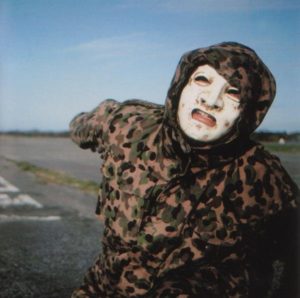 Warning! Attention, everybody! For the first time since the 1980s, London’s ethnic communities must fear for their safety when certain rock bands come to town. As the Love Music, Hate Racism website warns us in bold letters, the Slimelight club in Islington, North London has booked a “set of acts with fascist ties” for October 2011. These include Peter Sotos, who “has written tributes to Joseph Mengele (also known as the Angel of Death in Auschwitz) and whose self-produced fanzine contains references to ‘Nazi triumphs’, with frequent and lurid references to the abuse of children and women.”1
Scary stuff.But that is not all. Despite protests by Love Music, Hate Racism and other anti-fascist groups, the Slimelight club has already hosted a fascist concert on June 25. According to LMHR, the artists on the bill all had “a long association with fascism and racism” and “seek to attack our celebrated multicultural society”. Did neo-Nazis go on a violent rampage through Islington’s Upper Street? Did they abuse women and children? After all,“the well-known Nazi organisation Stormfront stated on their website that their members will be attending the event”, and a report in the Islington Gazette quoted Unite Against Fascism joint secretary Weyman Bennett as finding the prospect of such a concert “worrying”. Even Labour MP Emily Thornberry got in on the act, arguing that “these peddlers of poison” had no place in Islington.
Truth be told, LMHR could have been more thorough with its research. Stormfront, for instance, is not actually a “well-known Nazi organisation”, but a far-right internet discussion forum with headquarters in West Palm Beach, Florida. As such, it provides a means of communication for ‘racially aware’ misfits the world over, but it would be wrong to say that it has “members” who might collectively goosestep to the concert. “I was a bit tempted to go to the gig just to see what would happen,” a London-based Stormfront user nicknamed ‘Saxon Assassin’ admitted, “but after actually looking up the bands involved I think I’ll skip it”. Then the damning verdict fell: apparently, the musical programme on offer was “no more racially conscious than Springtime for Hitler”.
The original post ‘The Falcon’ had published on Stormfront on May 28 looked as if it had been inspired by an April 13 article from the anti-fascist website Who makes the Nazis, to which it linked. “I wouldn’t have heard about the gig were it not for the economic migrant lobby [ie, the left],” a surprised forum user crudely commented. Somewhat better informed, another contributor suggested that it “must be a slow news week over at Love Music, Hate Racism … Slimelight have been putting on gigs for years that could all in some tenuous way be ‘linked’ to fascism”. If that ‘well-known Nazi organisation’, Stormfront, is anything to go by, then the far right would have barely registered the concert had it not been for the anti-fascist coverage.
In the end, absolutely nothing happened – and perhaps, nothing was going to. Leaving aside that Islington’s yuppie mile, Upper Street, is hardly a prime target for white racist assault, it is difficult to imagine the goths that pranced towards Slimelight that night chasing anybody down the road – the opposite scenario seems a more plausible proposition. Contrary to the impression one might have gathered from the LMHR pamphlet, the bands playing at Slimelight were no violent bonehead combos, but acts from the neofolk milieu. An outgrowth of industrial music and post-punk, neofolk blends traditional European folk influences with experimental arrangements and electronic textures to varying degrees. Because of its fondness for the apocalyptic and the irrational, it is mainly consumed by darkwave and goth audiences.
Totalitarian
 Slimelight regulars vented their anger at LMHR’s “totalitarian” campaign at None so deaf as those who will not listen, a Facebook discussion group set up by Slimelight owner Mayuan Mak when LMHR continued to delete his comments from its website.[2] Most posters displayed convincing political inarticulacy, betraying a conventionally liberal rather than fascist mindset. The extreme left is just as bad as the far right – that was the predictable tenor. The ensuing furore gave Mak the opportunity to present himself as a patron saint of London’s alternative community, and in a letter to the Islington Gazette he posed as a law-abiding model citizen. Challenging anti-fascists to document any actual incitement to racial hatred promoted by the targeted bands, he demanded that the hate laws which “many people have suffered and died for” be used against those deserving punishment – such as Islamist nut-job Abu Hamza, for example, whose prison sentence Mak was quick to cite as “the way forward”.
In fairness, Love Music, Hate Racism misquoted him as saying that “fascism is an art form as well”. In truth, he said that “art can be fascist too”[3] – not at all the same statement. But let us turn our attention to the artists on the bill. The openers were named Joy of Life, though you would not come up with that name if all you had to go on was their dreary 1980s indie rock. What tied them to the other acts – Sol Invictus, Freya Aswynn and 6 Comm – was their linkage to the pioneering neofolk band Death In June, on whose record label they had debuted.
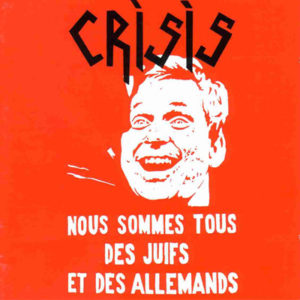
Tony Wakeford, a founding member of Death In June and front man of Sol Invictus, may have been overcome with nostalgia when well-meaning socialists picketed his concert outside Slimelight. Once upon a time, he was one of them: Wakeford’s status as a card-carrying member of the Socialist Workers Party secured his punk group Crisis numerous performances for Rock against Racism, the 1970s predecessor of Love Music, Hate Racism. Crisis vocalist Doug Pierce, meanwhile, was a member of Tariq Ali’s Trotskyist outfit, the International Marxist Group – a connection that allowed Crisis to play at events such as Workers Against Racism.
In contrast to the intuitive socialism of The Clash, Crisis songs featured immortally literal lines, such as “urban terrorism is no substitute for building the revolutionary working class party”. In theory, the band members’ respective central committees could not have been more thrilled. But, as Pierce remarked in hindsight, “there is no pleasing some people”.[4] By 1980, Crisis routinely complained how the leftwing organisations still distrusted the band and their unruly punk fans: “We feel more alienated playing at their events than at normal gigs,” Pierce lamented. Cheques they had been promised never arrived, and funds raised by Crisis through gigs were not donated in the band’s name. According to Wakeford, the group felt thoroughly “used and patronised” – a familiar feeling to anyone who has ever been an obedient foot soldier to an arrogating party leadership.
Some may well wonder what revolutionary would attach such importance to being name-checked when making a donation. Even so, a range of interviews give the impression that Crisis were sincerely committed to the party line. And just as many apparatchiks, in their heart of hearts, imagine themselves as future Trotskya and Lenins, Crisis may have well envisioned themselves as official soundtrack composers for the great revolutionary crisis, which was, of course, just around the corner. To the extent that they are not politically controlled, the self-seeking modes of social interaction that characterise capitalist societies are bound to be carried over into relationships between revolutionaries; Pierce and Wakeford, it appears, used the left to gain exposure no less than the left groups used Crisis to advance their respective sect interests. The bureaucrats, however, were made of baser wood than the young punks: Crisis became disillusioned and left the building.
Guilty have no pride
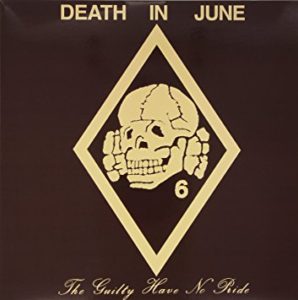 That’s when Pierce and Wakeford began to take an increasing interest in the ‘other side’. It would be an understatement to call that interest unhealthy by the time they recorded their 1984 debut album as Death In June. The guilty have no pride, went the album title, and lines such as “the once proud brownshirt soon betrayed by engineers of blood, faith and race” were put to a Joy Division-like soundtrack of wandering bass lines and martial drums. Those familiar with Strasserism were not left guessing as to what was being played here: the left factions of the NSDAP – from Röhm’s SA to Strasser’s breakaway Black Front – were whitewashed of racism and idealised as national socialist movements betrayed by Hitler’s counterrevolution. In keeping with this theme, Death In June’s Brown book album (1987) contained the SA anthem ‘Horst-Wessel-Lied’, sung like a funeral dirge.
Death In June’s persistent use of fascist themes in lyrics and artwork is often seen as mere flirtation with taboo subjects: a desire to shock, a morbid fascination with the dark side of history, or, as some fans suggest, no more than gay men sublimating their fetishistic sexual fantasies into art. But despite his continued evasions and deliberate confusion-stirring elsewhere, Pierce was unmistakable in a 1995 interview: “In search of a political view for the future we [the early Death In June] came across National Bolshevism, which is closely connected with the SA hierarchy. People like Gregor Strasser and Ernst Röhm, who were later known as ‘second revolutionaries’, caught our attention” (my emphasis). And, broadly speaking, their artistic preoccupations have remained in the strange and depressing universe of völkisch mysticism, Germanic runes and the occult.
While his band-mates abstained from organised politics, Tony Wakeford became a paid-up member of the National Front, belonging to the Nick Griffin-led, Strasserite ‘political soldier’ faction. He was quickly dropped from Death In June when this transpired, possibly with a view to the goth scene’s first stabs at mainstream chart success (Temple of love anybody?). Founding band member Patrick Leagas persevered for another two years; after a 1985 concert in Bologna, during which the band performed in Nazi-like uniforms, a woman from the audience shouted at Leagas, “I hope your mother hates you”.[5] This was devastating enough for the sensitive Leagas to quit DIJ – but not devastating enough to keep him from forming the electro combo 6 Comm, which delighted the Slimelight audience on June 25 2011 with songs from their retrospective Like Stukas angels fall.
Wakeford’s next project, Above the Ruins, gave us darkwave ‘protest songs’ against race mixing and contributed a track to the National Front benefit album No surrender. This outfit, in turn, was the nucleus of Sol Invictus. Like Death In June, Sol Invictus have subsisted in an obscure rightwing bohemia of neo-pagans, occultists and ‘radical traditionalists’ of one sort or another. Wakeford became involved with the esoteric fascist ‘think’-tank Iona and, like numerous neofolk artists after him, became infatuated with Julius Evola, the ‘radical traditionalist’ philosopher from Mussolini’s Italy. Evola, author of Revolt against the modern world (1934) and The Aryan teachings of struggle and victory (1941), was so contemptuous of the masses that even the ‘Reichsführer SS’ Heinrich Himmler considered him a “reactionary”: when working for the SS think-tank Ahnenerbe in the 1940s, Evola was put under observation.
Decline of the west
 In contrast to white-power rock of the Skrewdriver variety, which is not known for beating around the bush, the music of bands like Death In June and Sol Invictus thrives on ambiguity and has little agitational value. The acoustic strumming and Burzum-styled ‘mystical’ keyboard lines, interspersed with cinematic samples and assorted atmospherics, are hardly the stuff that sharpens you up for a bit of the old ultra-violence.
Death In June’s introvert, often haunting songs are informed by the gloom and sense of loneliness commonly expressed in darkwave. Fans usually interpret the melancholy as despair at the human condition, the poetic references to war and struggle merely reinforcing this basic premise. A song such as ‘Rose clouds of holocaust’ (“the angels of ignorance fall down from your eyes, rose clouds of holocaust, rose clouds of lies”) in no way flirts with holocaust denial, they say, since Pierce explained in an interview that the word ‘holocaust’ also means ‘burnt offering’ – quite a relief!
Arguably, the melancholy and despair represent neofolk’s aesthetic appropriation of the cultural pessimism that informed the ‘conservative revolutionaries’ of the Weimar republic. One of Death In June’s best known songs is ‘Death of the west’ (1985). Like much later neofolk, it expresses an aversion to materialism and ‘bourgeois decadence’ akin to that which informed authors such as the Freikorps favourite, Ernst Jünger, and the more highbrow Oswald Spengler, whose influential philosophical treatise was incidentally named The decline of the west (1918; revised 1922). The ‘German socialism’ that Spengler envisioned as an antidote to corrupt capitalist democracy was one where orders were given and obeyed, where everybody had their strictly allocated place in society, and where classes would collaborate for the common good – not unlike the ideas that fascists such as Doug Pierce’s beloved Ernst Röhm championed, as they opened the gates to unprecedented barbarism.[6]
To these reactionaries, democracy was synonymous with the rule of money: theirs was an anti-capitalist critique from the right – or, rather, from the past. Like some of their Marxist contemporaries, they identified parliamentary democracy as the bourgeoisie’s preferred form of rule. Unlike them, they advocated the rule of a ‘naturally superior’ neo-feudal elite over all classes to contain the excesses of capitalism. Because they conflated capitalist democracy with egalitarianism, their premise was diametrically opposed to Marxist thought: to be sure, they feared the rule of the ‘rabble’ more than anything. When they criticised the really existing fascist regimes, in which they came to find their closest match, they lambasted their ‘mob character’, deeming them not aristocratic enough. As is well known, fascism in power quickly forged alliances with the national bourgeoisie, running roughshod over any anti-capitalist fancies.
Moreover, some in the neofolk scene are well acquainted with the theories of the nouvelle droite (‘new right’), particularly those of Alain de Benoist. De Benoist, a French intellectual who fancies himself as the Antonio Gramsci of the right, would actually be better described as fascism’s answer to the neo-‘Gramscians’ of left academia. Like them, De Benoist advocated a ‘war of position’, as outlined in Gramsci’s Prison notebooks, but without the complementary ‘war of manoeuvre’. After World War II and that unfortunate gaffe, the holocaust, cultural work would be the only way forward. Activists would covertly infiltrate the superstructure and gradually influence certain groups into adopting key concepts of fascist ideology. Won over largely by aesthetical means, these would then form a hidden army prepared to strike on the Great Day. Until then, open political work would be futile.
Declassed bohemia
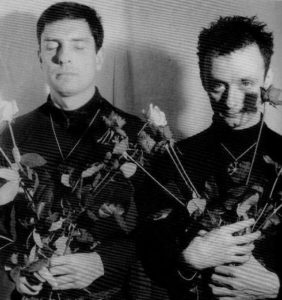 It is easy to see why some underground musicians might find such a concept appealing. To a certain type of artist, the glamour of producing culturally subversive work – let alone in the name of a movement so dangerous it dares not speak its name – is everything they could wish for. It allows someone like Doug Pierce to shroud himself in mystery and keep people guessing: is he ‘really’ a fascist, as the lefties claim – or merely a misunderstood artist?
The perpetual controversy keeps the cash flow going and, although real mainstream success is not on the cards, Pierce has certainly carved out a niche that pays the bills. A nod and a wink here, a cop-out there – Pierce positively enjoys sending out contradictory messages and ambiguous sound bites. To aggravate anti-fascists is dead easy, after all. And, as far as his fans are concerned, not even Pierce’s solidarity visits to the neo-fascist HOS militia in the midst of the Balkans conflict is a political statement. For Pierce is an artist, and apparently artists are above politics.[7]
For all those curious to learn about the Death In June ‘family’ and their associates in detail, there are websites such as Who makes the Nazis, which aims to expose “fascist presence in ‘transgressive’ musical subcultures”. Musicians’ political histories and personal links are documented with almost Stasi-like precision – any suspicious information is meticulously collected and catalogued. Who shared a bill with what other band in the past? Who appeared alongside whom on what compilation album? What band’s ex-guitarist shared flats with a bonhead back in the 80s? In contrast to the characteristically crude Love Music, Hate Racism write-up, the people running Who makes the Nazis know their subject well. However, the ‘guilt by association’ method they employ has its limitations.[8] Ditto the notion that, once an individual has internalised and vomited up enough reactionary ideas, the sum of it all equals fascism and is bound to spread like a virus. Moreover, to accept uncritically the new right’s belief that fascism can take over by means of cultural infiltration leaves a lot to be desired.
Take, for instance, David Tibet of experimental folk outfit Current 93, a close associate of Death In June and guest contributor to many of their albums. In a 1988 interview[9]Tibet expresses his disenchantment with “spiritually and morally corrupt” western culture and society, which he perceives as “tedious” and merely striving for “shallow pleasure”. “When you see people in the street,” he laments, “their shoulders are bowed in defeat. They realise they are living completely meaningless lives and there’s nothing to look forward to.”
Tibet’s alienation with the hollowness of late capitalist culture is certainly shared by many on the left, but he lacks the tools to identify any relationship between culture and its socio-economic base. Culture, for him, is some free-floating, autonomous entity that continues to exist in its present form because those docile sheep in the street lack the willpower to overcome it.
If you will, it is here that Tibet’s outlook, coupled with millennial angst and an intense interest in mysticist mumbo-jumbo, has points of intersection with fascist thought, and it is not difficult to see why Tibet and Pierce, when introduced, got on like a house on fire. Yearning to create art that stood in contradiction to capitalist mediocrity, they were both looking for authenticity in traditional and pre-modern thought, counterposing the eternal, the mystical and the metaphysical to the mundane, misunderstanding capitalism’s commodity fetishism as ‘materialism’ – much like the traditional elites and disenchanted sections of the middle classes had done, as they turned to völkisch romanticism at the turn of the 19th century.
Faceless crowds
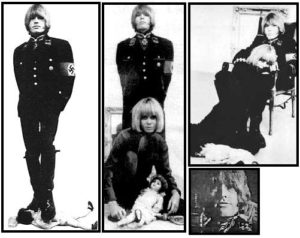 As bohemian mindsets go, Tibet’s is not unusual. Elitism and a complete detachment from the masses had been a hallmark of countercultural pop rebellion ever since the 1960s. “Those people never had any power and they never will have” is how Sir Mick Jagger explained his motivation behind the Rolling Stones tune, ‘Salt of the earth’ (1968). As France saw the biggest mass strike in modern history, Jagger sneered at the “common foot soldier” and his “back-breaking work” – but one entry in his almost consistently reactionary lyrical oeuvre. In the 1980s, British workers were engaged in an all-out class war against the Thatcher government rather than leading “meaningless lives” and “hanging their shoulders in defeat”, but from David Tibet’s candlelit hideout, they all just looked like the “faceless crowd” depicted in Jagger’s song.
Neofolk’s spiritual path was paved by artists such as Jim Morrison, the Nietzsche-fixated ‘shaman’ of narcissistic gloom pop. In the 70s, David Bowie, Joy Division and others introduced murky, fascist flirtations into that particular arena, and you might argue that the sum of their cultural pessimisms and aesthetical derailments does not place them a million miles away from Death In June and Current 93. Likewise JJ Burnell of The Stranglers – like Doug Pierce an admirer of the Japanese author, Yukio Mishima, and guilty of Euroman cometh, an album crammed with ‘Eurocentrism’, unreconstructed 19th century nationalism and unintentional humour galore.
You may even want to file indie-pop luminary Björk in the ‘brown book’. Did she not, after all, join forces with David Tibet for the 1991 song ‘Falling’ – and is Björk’s mythologisation of her ‘mystical’ Icelandic home not somewhat akin to neofolk’s Nordic fantasies? To make matters worse, Steve Ignorant of Crass, the anarcho-punk band par excellence, not only supplied guest vocals to Current 93’s Dog moon rising album, but also featured on a Current 93 recording alongside Boyd Rice, who is known as a sinister “social Darwinist” to industrial music fans and as an “unemployed, alcoholic fascist” to his ex-wife, Lisa Crystal Carver.[10] And were not Crass hostile to the organised left, whilst adhering to a Proudhonist type of anarchism – just as ‘national anarchists’ do these days?
So where do you draw the line? What if most musicians simply do not screen their collaborators and drug buddies for political beliefs? What if ‘meta-fascism’ blends so easily with the common outlook of declassed bohemia that it simply dissolves in a swamp of amorphous self-indulgence? At Who makes the Nazis, writers are at pains to deliniate who is “definitely” a fascist and who is just a fellow traveller, eccentric or imposter. But, despite the sometimes intriguing cultural analysis and obsessive evidence-collecting, their attempts to identify a point where quantity becomes quality clearly give them a headache. Maybe that is because fascism never really had a coherent ideology – rather, it took any resentments, prejudices and fragments of reactionary thought that happened to cross its path and tossed them into its grubby, populist rag-bag. As Leon Trotsky remarked in reference to German national socialism, its ideological “beggar’s bowl” preserved “whatever had met with approbation” during Hitler’s early speeches. Hitler’s “political thoughts were the fruits of his oratorial acoustics … That is how the programme was consolidated”.[11]
Aesthetical mobilisation
 This is not to claim that fascism has no distinct character that renders it qualitatively different to other types of reactionary politics – it is just that this difference is less clearly defined by what it thinks as by what it does.
Chauvinism and racism were the hallmarks of fascist thought in the 20th century, but were not unique to them. What distinguished fascist movements was their mass base and the street-fighting divisions they sent out to smash working class organisations. To gain mass appeal, fascism had to radicalise sentiments already held by broad sections of society: the selective anti-capitalism of the middle classes, directed solely at big business and international finance capital; their simultaneous fear of the working class and of Bolshevism; the indignation of the unemployed university graduate; the demobbed German officer’s bitterness over the lost war and the 1918 revolution, mythologised as a ‘stab in the army’s back’; the latent anti-Semitism that permeated all of the above. It is true that the writings of Spengler and Evola had a place in fascist libraries and kept the odd Nazi intellectual busy. But how many exasperated Germans who turned to the NSDAP will have read The decline of the west, when most of them had not even read their copies of Mein Kampf?
Had the Nazis attempted to disseminate haute fascism through cultural brainwashing techniques, they would have waited a long time. Instead of recognising the sub-Gramscian strategy for the dark horse that it is, anti-fascists simply seem to accept the post-fascist ‘aesthetics are everything’ premise, according to which cultural warfare can be an effective substitute for political organisation and mass mobilisation. What is clearly missing from books such as the German-language Ästhetische Mobilmachung,[12] which deals with the ideology of neofolk in exhilarating detail, is the most critical question of all: does the strategy work? In reality, the moment ‘cultural fascism’ leaves its ivory towers and attempts to influence the mainstream, it becomes indistinguishable from conventional bourgeois thought: in his column in Le Figaro, Alain de Benoist polemicised against further immigration, but in support of multiculturalism on the grounds that it preserves the ‘identities’ of immigrants – a view that many in the Labour Party would agree with.
Even in the marginal subcultures in which ‘cultural fascism’ has attempted to gain a foothold, its successes have been humble for the past 20-odd years. Despite the concerted effort of far-right newspapers, such as Germany’s Junge Freiheit and neofolk magazines such as Sleipnir, the European darkwave scene has proved overwhelmingly immune to politicisation. Some newer industrial bands, such as the insufferable Von Thronstahl, are more explicitly fascist than the likes of Death In June. But, for all their underground popularity, they are consumed in much the same way as any other post-industrial band, the listeners’ interest rarely extending beyond the momentary thrill of the forbidden.[13] “There are some far-right people who think that neofolk is the thing,” wrote a fan on Mak’s None so deaf … Facebook group, “but they are very few and generally not well received in the neofolk scene”; and furthermore: “I remember seeing a few years back far-right neofolk fans on Stormfront bemoan the fact that neither neofolk fans nor artists are receptive for their ideas.”
But let us assume for a moment that fascism really is some kind of ideological virus bound to infect people’s minds upon exposure; I will even grant that ‘meta-fascism’ might resonate with the world-weariness and latent elitism of the darkwave crowd. What then, precisely, would the extreme right gain from the support of a fundamentally insular and self-absorbed subculture? Rather than heralding a triumphant march through the institutions, this would more likely be an act of self-sabotage. Too strong is the scene’s distaste for concrete politics, mass movements and physical violence to provide fertile ground for fascism.
To catch on, a fascist movement must resonate with the frustrations and fears of broad sections of society. In this respect, a formation such as the English Defence League – anti-Muslim and populist in tone – looks far more promising. The EDL elevates the creeping decline of imperialism into a millennial ‘clash of cultures’, aggressively asserting the ‘liberal values’ of the west against the ‘barbarism’ of Islam. And, perhaps most importantly, the EDL does not shy away from violence. In other words, it is everything that the meta-political ‘new right’ is not: the seed of a fascist movement fit for the 21st century.
Much though esoteric rightists delude themselves that their ideas are transhistorical and ‘natural’, they are in fact ideological constructs borne of specific historical conditions. Tales of a Jewish ‘world conspiracy’, paganism and other such candyfloss-brained baloney are unlikely to strike a chord with broad masses in the 21st century. The defence of ‘our way of life’ against Islamic extremists, ‘greedy’ trade unions and political correctness, on the other hand, might just do the trick. The greatest problem of the nouvelle droite has always been fascism’s lack of political substance. Divorced from social realities, devoid of street-fighting squads and lacking a mass base, it really is reduced to little more than obscure, metaphysical drivel.
An acquaintance involved in the protests against the Slimelight concert asked me whether such an event would not risk pulling some people rightwards. If at all, went my reply, then immeasurably less so than permanent exposure to the Daily Mail and the Murdoch media, which imbue millions with their ‘common sense’ every day. Three weeks after our conversation, the Norwegian fascist Anders Breivik massacred several dozen leftish teenagers with the calm determination of an SS Einsatzgruppen officer. In his manifesto, he cited the Mail scribe and Londonistan author, Melanie Phillips, the radical Islamophobic Gates of Vienna blog and other such contemporary rightwing texts rather than Evola, Jünger or Spengler. His paranoia of “cultural Marxism”, meanwhile, is common currency with Andrew Breibart, Glenn Beck and other Fox News luminaries.
School of libertinage
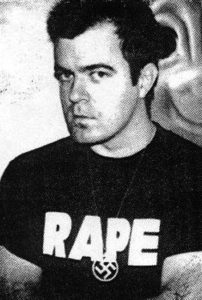 Just a few words about Peter Sotos, whose forthcoming Slimelight appearance LMHR also chose to oppose. Pioneer of a sub-current of industrial music christened ‘power electronics’, Sotos’s declared mission was to record the most extreme music of all time – and he complemented his band Whitehouse’s invasive noise fest with the most misanthropic lyrics he could think of. Industrial pioneers Throbbing Gristle, whose leader Genesis P Orridge obsessed over Charles Manson, Hitler, Aleister Crowley and other subjects that his schoolteachers might consider shocking, had laid the groundwork. Pushing a radical libertarianism, Sotos went further celebrating sadistic Nazi death camp wardens and child porn.
Like Throbbing Gristle, he was tilting at windmills, unaware that the humanist values he so despised were the mere facade of a social system built on exploitation, oppression, violence and war. Barack Obama, the hope-and-change man of liberal America, has inflicted more death and misery upon the world than the likes of Peter Sotos could ever dream of. Boyd Rice, industrial music’s resident misanthrope, looks like a boy scout next to David Cameron and the class he represents. In their minds, Sotos and Rice might feel quite at home in the 120 days of Sodom – but in the real world, evil is not the triumph of the libertine’s will, but the unglamorous, monotonous, barren by-product of class society.
Peter Sotos’s main body of work, including the misanthropy fanzine cited on its website, dates back to the 1980s, which makes it hard to fathom what danger this concert is supposed to pose. “If left unchallenged, the actions of these individuals give confidence to fascist and racists, providing an illusion of mainstream acceptance of their vile views”, claimed LMHR. Does anyone at LMHR really believe that Sotos’s graphic depictions of rape, serial murder and paedophilia will endear him to the far right – or give it “an illusion of mainstream acceptance”? You would have thought that the precise point of his act is to evade mainstream acceptability as much as possible.
For LMHR, the language of liberalism is, sadly, too often used in its ‘anti-fascist’ campaigns, holding up “our celebrated multicultural society” against the cheerless delusions of neofolk rightists. ‘Proletarian internationalism’, after all, might scare off fellow travelers such as the liberal, Emily Thornberry. However, all the inaccuracies and half-truths, deliberate suppression of information and ensuing atmosphere of hysteria do more harm than good. “These people totally discredit themselves by refusing any discussion,” observed a Slimelight regular correctly. LMHR’s philistine anti-fascism is far more likely to alienate the alternative scene from the left than cleanse it of reactionary ideas.
Anti-fascists could do worse than refocus their energies on the system that breeds fascist degenerates. Fascism, after all, is a punishment for our failure to make revolution – and our struggle against capitalism inevitably involves a struggle against the liberal hogwash that upholds the ‘legitimate democratic forces’ of the bourgeoisie against ‘extremists’ and ‘hate’. Those who are offended by post-industrial music and wish to keep it in obscurity, meanwhile, would be better advised to simply ignore it. In the end, these gigs are just the dying breath of a cultural revolution that never was.
Notes
- Love Music, Hate Racism, ‘Say no to Nazi bands in north London’: http://lovemusichateracism.com/2011/06/say-no-to-nazi-bands-in-north-london.
- The Facebook blurb stated among other things: “We are not best informed at the Slime office to verify truth, authors’ bias or ulterior motives in order for us to assess the information that they have passed to us. In response we have requested publicly online for any negative and positive information, verifiable against a published, reliable source, not just rumour or hearsay, to assist us, the local authorities and lovemusichateracism.com to come to an informed decision on whether this concert should be held. We have now been told by lovemusichateracism.com they have no interest in reading any information that we gather from Slimelight members/regulars [or any other source, it would appear].”
- www.islingtongazette.co.uk/news/online_campaign_attacks_controversial_islington_gig_1_914659.
- www.occidentalcongress.com/interviews/intdoug_06.htm.
- Five years earlier, a fascist terrorist bombing killed 85 people at Bologna’s main central station and injured many more. At this time, the local government was dominated by the Italian CP.
- In Spengler’s words, what was needed was “a mighty politico-economic order that transcends all class interests, a system of lofty thoughtfulness and duty sense”. In other words, Spengler wanted a class society without class antagonisms – a political paradox that calls for an external enemy on which to project suppressed contradictions.
- In an interview about his early punk days in Crisis, Pierce explained the origins of his cynical approach as follows: “We wrote with that marching rhythm in mind the song ‘White youth’, which we thought was about ‘unity and brotherhood’ [the song ends with the repeated verse, “We are black, we are white – together we are dynamite”], but much to my surprise some smartarse in the New Musical Express was soon saying that it was a white supremacist anthem … That was key in realising that, no matter what you wrote, if it was any good it could be interpreted any way, anyhow, anywhere. A Death In June prime directive!” (www.occidentalcongress.com/interviews/intdoug_06.htm).
- The comrades at Who makes the Nazis would also be well advised to be more critical of information from Searchlight, whose relationship with the truth (and the MI5) is not uncontroversial. The organisation has furthermore been known to call for state bans against ‘extremists’.
- The interview can be seen at www.youtube.com/watch?v=20XSDKbFj2w.
- A Who makes the Nazis article on Boyd Rice can be found at www.whomakesthenazis.com/2010/10/just-say-non-nazism-narcissism-and-boyd.html.
- L Trotsky What is national socialism? (1933) www.marxists.org/archive/trotsky/germany/1933/330610.htm.
- Ästhetische Mobilmachung is a fairly interesting account (if you speak German), but to be taken with a pinch of salt, given that the authors hail from the ‘anti-German’ end of the ‘undogmatic’ left. Centred around papers such as Jungle world, the pro-US/pro-Israel ‘anti-Germans’ make it their business to detect ‘fascism’ and ‘anti-Semitism’ everywhere. See www.unrast-verlag.de/unrast,2,5,5.html.
- On a side note, some may be surprised to hear that the neofolk website Heathen harvest considers the communist-themed martial industrial act, Vae Victus, to be “very enjoyable”. Candidly noting that band leader Peter Iolin considers himself to be a “revolutionary socialist”, the website gave his debut EP a positive review. See www.heathenharvest.com/article.php?story=2008083110530947&query=.