Originally published on Red Mist Reviews in May 2011
 “Where are they now?”, asked a 1982 song by South-East London band Cock Sparrer, lamenting the faded and lapsed heroes of British punk. The answer was simple. Some of the addressees of the lyric, such as John Lydon and Joe Strummer, had moved on to create more adventurous music (Public Image Ltd. and Sandinista! respectively). Lesser lights, such as Sham 69’s Jimmy Pursey, had run out of ideas that might justify another album of two-chord chantalongs, leaving the spotlight to a new breed of dole punks operating under the ‘Oi!’ umbrella.
The latter, in turns, provided opportunity to namecheck the never-have-beens of gritty working class rock and roll; bands such as Heavy Metal Kids, formed years before the Sex Pistols, had seen punk come and go. Ditto Cock Sparrer, originally a Faces-cum-Slade pub rock combo and now reuniting to entertain a handful of devoted skinheads and casuals. ‘This time it’s real’, went the motto of Oi!, and Cock Sparrer utilised their classic rock songwriting skills to craft some of the most street-smart, sincere, and anthemic material associated with the punk genre. You could almost smell the lager and fish ‘n’ chip shops.
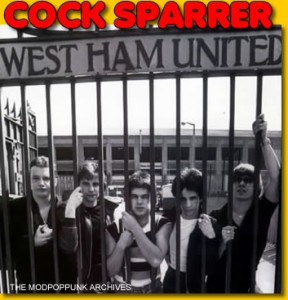
So where are they now? While a new Cock Sparrer line-up is still doing the rounds on the punk nostalgia circuit, their former guitarist and main songwriter, Garry Lammin, assembled a new band named The Bermondsey Joyriders. Also on board are bassist Martin Stacey (ex-Chelsea of Right to Work fame – the song, not the SWP front) and, more recently, Rat Scabies of The Damned on drums. Performing at London’s 100 Club, the cockney super-group promoted their second album, Noise and Revolution. Now, revolution is not an unheard of buzzword in rock parlance, but when a band invites the founder of the White Panther Party, John Sinclair, to accompany their performance with spoken word, you get the impression they try to make a point.
Truth be told, this was a strange combination. 1960s relic John Sinclair, after all, had led the vanguard of American college drop-outs and would-be guerrillas to demand “dope, guns and fucking in the street” while dropping acid for breakfast and mismanaging the MC5. Cock-Sparrer, in contrast, were moderates. “We don’t want to fight because you tell us to”, they insisted on ‘Watch Your Back‘, a song that not only likened revolution to the ‘final solution’, but promised to turn on the left and right equally if either decided to “attack”.[1] Add to this the flag-waving of ‘England Belongs To Me’ and various football aggro songs, and you’ve got the kind of self-defeating conservatism that drives sensitive socialist students to despair.
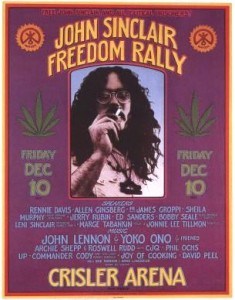
The event at the 100 Club could have turned out to be just another nostalgic meetup, further cementing punk’s status as part of the classic rock canon – a reminder of the good old days when music was ‘real’. But it actually worked on a number levels, some of which may well have been unintentional. Aptly, the silver-haired John Sinclair sat on the far left of the stage, looking on to the Bermondsey Joyriders, who had taken position on little Union Jack rugs, with a benevolent yet bittersweet expression.
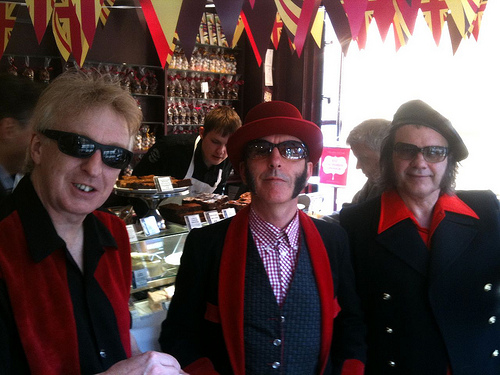
The Joyriders sported massive sideburns, bowler hats, and other attire of days gone by, which resulted in a look somewhere between Slade, A Clockwork Orange, and Victorian England. Sinclair played the role of the narrator: “As the Bermondsey Joyriders were contemplating noise and revolution, the neighbourhoods were being torn apart by greedy property developers,” he read out in a quiet, raspy tone. Age had lent the man dignity, and his presentation was remarkably free of ‘far out’ freak politics.
“Things were disintegrating. Society was rapidly changing,” Sinclair finished his introduction ominously. These words triggered the opening chords of what was an awesome culmination of middle-age angst bottled in a raging three-minutes rock ‘n’ roll song. “Society! Is rapidly! Chan-ging!” chanted the gravelly-voiced Garry Lammin while bashing out Pete Townshend styled bar chords. The messenger was clearly not enthusiastic about the news.
The Bermondsey Joyriders carry their concept in the band name. As London’s Docklands are becoming a site for exclusive apartment blocks, local youths have found a new hobby: they joyride yuppie colonisers’ cars and then torch them ceremonially. What radical anti-gentrification activists would ‘theorise’ as a political action in Berlin is done spontaneously and unpretentiously in Blighty. “We don’t advocate it, but we can understand it,” commented Lammin in an interview with the American punk zine Sonic Lobotomy. When prompted whether this was an expression of the class struggle, he replied in the affirmative.

Back at the 100 Club, the rhythm section, made up of Martin Stacey (he self-describes as a royalist on Facebook, and I’m not sure he’s being ironic) and Rat Scabies (a self-described anarchist), hammered away at ‘Society’ as Lammin yelled: “Look at that place over there – used to be a library! They don’t do books in there now – all they do is computer games”. His over-the-top delivery accentuated the band’s theatrical tongue-in-cheek posture, typically English in how he used humour to feign distance from what he, in truth, meant very seriously.
This was not just a song about gentrification. It was the desperate cry of a man who sees everything familiar evaporate before his eyes – rapidly. “All that is solid melts into thin air,” Marx wrote of the “uninterrupted disturbance of all social conditions” that characterises the bourgeois epoch; “all that is holy is profaned”. Lammin is on his way out, the world he calls home reduced to the childhood memory of a full employment era East End swinging to the beat of the Small Faces. He is afraid. “Nothing works, nothing is true, there’s nothing special, not even me and you”, he protests.
What kind of revolution, then, are The Bermondsey Joyriders contemplating? If we are to go by their sonic and visual time machine approach, then they – like much of the British labour movement – would ideally restore the certainties of the past, and I fear this ain’t gonna happen. But what the Joyriders do, they do well: a bit of Johnny Thunders here, a bit of bottleneck blues there; from T. Rex through bar room punk and The Kinks, it’s all splendidly executed, angry and… I guess ‘solid’ is the suitable word.
We cannot say for sure what their upcoming concept album Noise and Revolution, once again contextualised by John Sinclair’s narration, will bring to the table lyrically. For the time being, some song titles should serve as an indication: ‘Proper English’; ‘True Punk’; ’1977′. “Through all the changes, the Bermondsey Joyriders stand firm like London Bridge” is how Sinclair announced a song named after the landmark that sees a daily storm of suits and boots rushing to the offices.
Foot soldiers in a war that turns more desperate as the decades pass, the suits and boots can do no more than postpone unconditional surrender. If the Bermondsey Joyriders and the rest of us, however, want to emerge triumphantly on the other side, it’s time we took off the nostalgia-tinted glasses and became more ambitious about the future. The future not just of England, our town or our neighbourhood, but that of the human race at large.
[1] Howard Devoto penned a more paranoid variation of the theme with Magazine’s Shot By Both Sides three years earlier, while peace punks Crass vented their counterrevolutionary doubts in Bloody Revolutions (1980).